
India Manufacturing: Entry Strategy for Foreign Investors | Doing Business in India | Episode 24
GeneralJune 24, 2026
India’s manufacturing sector represents one of the largest industrial opportunities globally and a market firmly in transition. As the fifth-largest manufacturing economy in the world, India has emerged as a key beneficiary of the China-plus-one supply chain realignment, with global manufacturers increasingly evaluating the country as an alternative production base. The investment opportunity is significant, supported by a liberal foreign investment regime that permits 100% FDI under the automatic route across most manufacturing sectors. However, investors must navigate a range of operational and regulatory challenges before committing capital.
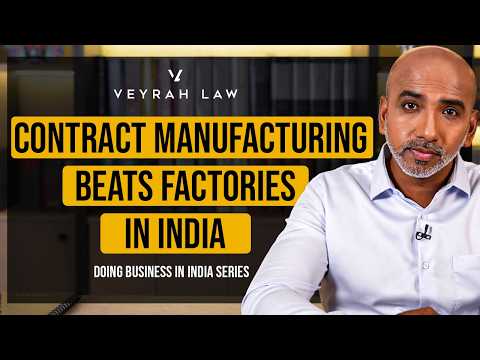
In this episode of the Veyrah Law series, Ajay Joseph (Partner at Veyrah Law) examines India’s manufacturing landscape, the policy initiatives driving industrial growth and the practical realities that shape investment outcomes on the ground. The discussion covers the 'Make in India' ambition to increase manufacturing’s contribution to GDP, the Production Linked Incentive (PLI) scheme and its role in attracting large-scale investment, land acquisition and state-level approval challenges, labour law considerations, union dynamics, corruption-risk management and structuring strategies for foreign investors. The episode also explores why contract manufacturing, joint venture structures, licensing arrangements and phased capital deployment often present a more commercially prudent entry strategy than immediate greenfield investment.

Keywords
- China-plus-one: A global supply chain strategy where manufacturers add a sourcing base beyond China.
- Automatic Route: FDI pathway allowing investment without prior government approval.
- PLI Scheme (Production Linked Incentive): Government incentive providing benefits based on incremental sales over a base year, covering 14 sectors.
- Manufacturing Clusters: Geographic concentrations of industry-specific supply chains, skilled labour and infrastructure.
- SEZ (Special Economic Zone): Designated industrial areas offering infrastructure and regulatory advantages, often used for export-oriented manufacturing.
- Contract Manufacturing: Engaging an Indian manufacturer to produce products to specified standards while avoiding direct operational exposure.
- Advance Purchase Contract: A commitment to buy a defined volume of a contract manufacturer’s output to align incentives and reduce entry risk.
- Buy-Out Option: Contractual right to acquire a contract manufacturer once the relationship and business scale are established.
- Technology Tap: A structure where core technology is licensed to, rather than owned by, the Indian entity, preserving parent-level control.
- IP Enforcement: The ability to protect intellectual property through Indian courts, including relief against counterfeiting and trade secret theft.
- Corruption Interface: Government interaction points like procuring licences, consents, utilities etc.
Timestamps
Production Date:
Recorded on 18 April 2026